




A design is registrable in India only if it is new or original. Section 4 of the Designs Act 2000 bars registration where a design has already been disclosed to the public anywhere in the world, or where it is not significantly distinguishable from designs already known.
This article covers Indian law only, under the Designs Act 2000 and the Designs Rules 2001 as amended to January 2021. Novelty and originality of design are tested first by the examiner at the Designs Wing, and again by anyone who later petitions to cancel the registration.
| Quick answer |
| ● Section 4 bars registration on four grounds: the design is not new or original; it has been disclosed to the public in India or any other country before your filing or priority date; it is not significantly distinguishable from known designs or a combination of known designs; or it contains scandalous or obscene matter. ● Disclosure is judged worldwide. A product shown on social media, at a trade fair, or in a catalogue abroad can defeat your own later application in India. ● Two narrow protections exist. Section 16 may apply where the circumstances imposed an obligation of good faith, including a later publication in breach of it. Section 21 covers only its specified exhibition and publication routes, and only if you give the Controller notice in Form 9 beforehand and apply within six months. ● The examiner runs a novelty search, class-wise or article-wise, before registration, and cites the prior art, meaning the earlier designs relied on, in the objection if the design is not new. ● DPIIT proposed a broad 12-month grace period for pre-filing disclosures in January 2026, regardless of how the disclosure was made. The concept note carries no draft statutory text, so whose disclosures would qualify is not yet defined. It is a proposal. Section 21 remains the law. |
What Novelty and Originality of Design Mean Under Indian Law
Section 2(d) defines a design as the features of shape, configuration, pattern, ornament or composition of lines or colours applied to any article, “which in the finished article appeal to and are judged solely by the eye”. It does not protect a mode or principle of construction, or anything that is in substance a mere mechanical device.
Section 4 then lists what cannot be registered: a design that “is not new or original”; one “disclosed to the public anywhere in India or in any other country … prior to the filing date, or where applicable, the priority date”; one “not significantly distinguishable from known designs or combination of known designs”; and one containing scandalous or obscene matter.
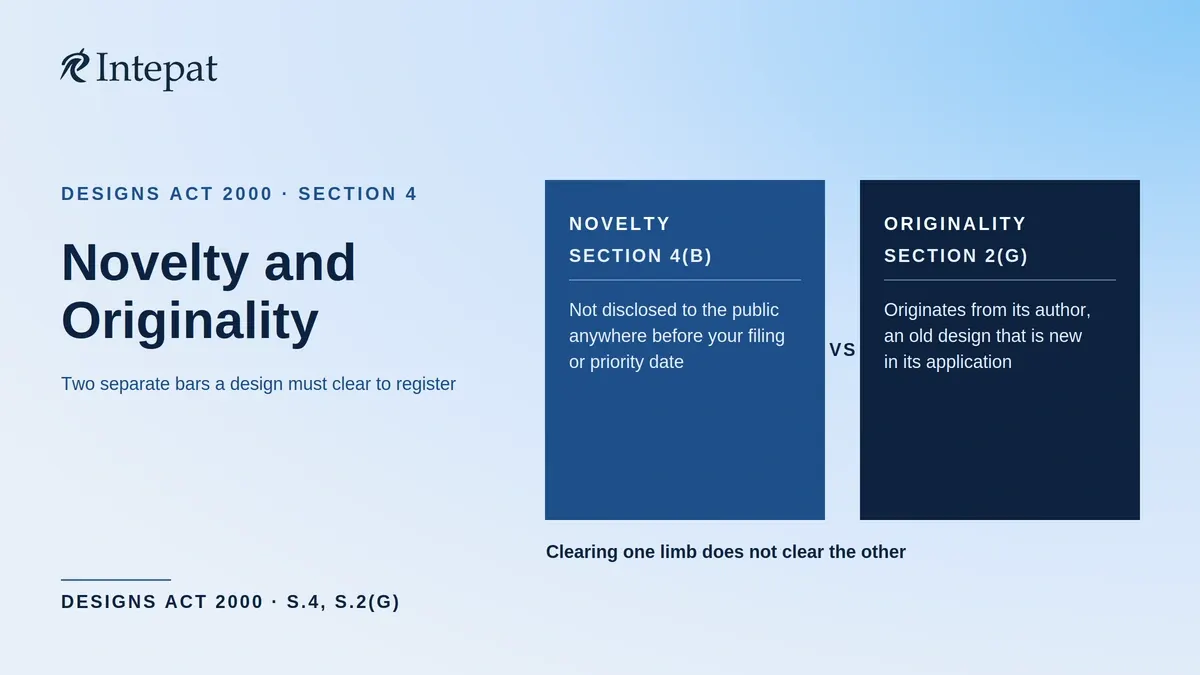
Note the “or” in Section 4(a): the statute asks whether a design is new or original, not both. Clearing that limb is not enough on its own, because Sections 4(b), 4(c) and 4(d) are separate bars. Section 2(g) defines “original” as “originating from the author of such design”, and expressly “includes the cases which though old in themselves yet are new in their application”. An existing shape is not automatically out of reach.
The two limbs answer different questions. Originality asks whether the design originates from its author, and covers an old design that is new in its application. Section 4(b) then asks whether the design has already been disclosed to the public, and Section 4(c) asks whether it is significantly distinguishable from designs already known. Originality excuses neither. Our guide to registrable and non-registrable industrial designs covers the subject-matter exclusions that sit alongside these tests.
What Counts as Prior Disclosure of a Design
Design novelty in India is judged against a worldwide pool, and Section 4(b) is deliberately wide. Disclosure counts if it happened “anywhere in India or in any other country”, and whether it came about “by publication in tangible form or by use or in any other way”. There is no territorial limit and no commercial-use requirement.
Indian courts read “published” broadly. In Rotela Auto Components (P) Ltd v Jaspal Singh, 2002 (24) PTC 449 (Del), the Delhi High Court held that a design “is published if a design is no longer a secret”, and that there is publication where the design has been disclosed to the public or the public put in possession of it.
There is a limit, and it turns on clarity rather than on the type of document. In Gopal Glass Works Ltd v Assistant Controller of Patents and Designs, 2006 (33) PTC 434 (Cal), the Calcutta High Court held that prior publication must be in tangible form, of the design applied to the same article, and that a catalogue, brochure, journal or newspaper depicting “the application of the design on the same article with the same visual effect” would suffice.
The Delhi High Court Full Bench in Reckitt Benckiser (India) Ltd v Wyeth Ltd, FAO(OS) 458/2009, decided 15 March 2013, approved that approach and applied it to foreign records. Mere existence of a design in the record of a Registrar of Designs does not in all cases amount to publication. The design must be presented with such clarity that its application to a specific article can be judged visually, and what amounts to publication is a question of fact decided case by case.
Your own disclosure counts against you: Section 5(1) speaks of a “new or original design not previously published in any country”. A publicly accessible launch post, crowdfunding page, catalogue or display can become the prior art that sinks the application where it reveals the design sufficiently. A sample supplied in confidence falls to a separate Section 16 assessment. A worldwide check before filing is still worth the time, though no search captures every sale or unregistered product. The WIPO Global Design Database is a free starting point.
Assessing a disclosure that already happened. Start with three questions. Was the design available to anyone not bound by confidentiality? Did the material show the claimed visual features clearly enough to be judged by eye? Had the Indian application, or the priority application it claims from, already been filed? Keep the records that answer them: confidentiality agreements, access restrictions, emails, sample-delivery records, dated screenshots, publication dates, the Form 9 acknowledgement and the relevant Gazette notification.
Originality: When an Old Shape May Still Be Registered
The Manual of Designs Practice and Procedure gives the working illustration. The figure of the Taj Mahal is centuries old, but a person who conceives, for the first time, the idea of a flower vase or an ash tray in that form may have originality. The Manual states that it does not have the force of law, so the example is practice guidance and not a determination of registrability. Every bar in Section 4 still has to be cleared.
Section 4(b) still applies. If that application of the design was publicly sold, used, or clearly disclosed in a catalogue before the relevant date, the design is no longer new, and independent creation does not help.
On proof, the Supreme Court held in Bharat Glass Tube Ltd v Gopal Glass Works Ltd, Civil Appeal No. 3185 of 2008, that the party challenging a registration bears the burden of showing the design was not new or original. The challenger there did not discharge it, because it had not proved that the rollers it relied on had been reproduced on glass sheets.
Why a Small Change to an Existing Design Is Not Enough
Section 4(c) is a separate bar, and it bites even where no identical earlier design is found. It bars a design that “is not significantly distinguishable from known designs or combination of known designs”.
In M/s Brighto Auto Industries v Shri Raj Chawla, ILR 1978 (I) Delhi, the court held that “a slight trivial or infinitesimal variation from a pre-existing design will not qualify it for registration”, and that “the change introduced should be substantial”. In Hello Mineral Water Pvt Ltd v Thermoking California Pure, 2000 PTC 177, the court observed that “mere novelty of form or shape is insufficient. Novelty involves the presence of some element or new position of an old element in combination, different from anything found in any prior structure.”
A design is not barred merely because its individual features were already known. What Section 4(c) asks is whether the resulting design, taken as a whole, is significantly distinguishable from known designs or combinations of known designs.
Comparison is by eye, and as a whole. Brighto Auto Industries holds that “in the matter of novelty the eye has to be the ultimate arbiter and the determination has to rest on the general ocular impression”, and newness confined to part of a design must still give the whole a distinct identity. This is why Rule 12, under which the Controller may require a brief statement of the novelty claimed on the application and each representation, matters. The Manual records that there is no need to pin-point a portion as novel, because novelty resides in the article taken as a whole. The design registration process in India shows where that statement fits.
Disclosures That May Not Count Against Your Novelty
Two provisions may stop a disclosure counting as invalidating publication, and both are narrower than founders expect.
Section 16 covers disclosure by the proprietor to another person “in such circumstances as would make it contrary to good faith for that other person to use or publish the design”, disclosure in breach of good faith by someone other than the proprietor, and acceptance of a first and confidential order for articles bearing a new or original textile design intended for registration. Each applies only if registration is obtained after the disclosure or acceptance.
Section 21 principally protects disclosures connected with an exhibition “to which the provisions of this section have been extended by the Central Government by notification in the Official Gazette”, covering exhibition of the design or the article and publication of a description during or after it. It also covers exhibition or publication elsewhere by any other person during or after the exhibition, “without the privity or consent of the proprietor”. The prescribed Form 9 is a notice of intended exhibition or publication, and it carries a separate option for intended publication by reading a paper before a society and permitting publication in that society’s transactions.
| Route | What it covers | What you must do | Timing |
| Section 16 | Disclosure made to another person in confidence; publication by that person in breach of good faith; acceptance of a first and confidential order for a new or original textile design | Keep the disclosure genuinely confidential, and be able to show it | Registration must be obtained after the disclosure or order |
| Section 21, exhibition | Exhibition of the design or article at an exhibition notified under Section 21, and publication of a description during or after it | Give previous notice in Form 9 before exhibiting at an exhibition covered by the required Gazette notification | Apply within six months from first exhibiting the design or article |
| Section 21, Form 9 publication option | Intended publication by reading a paper before a society, and permitting publication in that society’s transactions | Give previous notice in Form 9 before reading the paper or permitting publication | Apply within six months from first publishing a description |
Order matters under Section 21. Previous notice in Form 9 must reach the Controller before the intended exhibition or publication. Filing it afterwards does not open the Section 21 route. The six months then runs from the date of first exhibiting the design or article, or first publishing a description of it, not from the date of the notice.
Section 21 also does not cover trade fairs generally, only an exhibition to which the Central Government has extended the section by gazette notification, so assuming that any industry expo qualifies is likely to be wrong. The Form 9 notice itself carries a fee of Rs 500 for a natural person, startup or small entity, and Rs 2,000 for other applicants, under Entry 10 of the First Schedule to the Designs Rules 2001 (checked on 31 July 2026). That is the notice fee only; the application fee is separate. That applicant-category split, introduced by the Designs (Amendment) Rules, 2021, runs across the design fee schedule.
The 12-Month Grace Period DPIIT Proposed in January 2026
In January 2026 the Department for Promotion of Industry and Internal Trade published a concept note on proposed amendments to the Designs Act 2000. It records the position plainly: “Section 21 of Indian Designs Act is, however, very limited in scope. It offers a 6 months grace period in cases where the disclosure is made at exhibitions notified by Central Government.”
The note proposes “a blanket grace period of 12 months without any pre-conditions, and regardless of the manner of disclosure”, and names the disclosures it is meant to catch: online launches, investor presentations, pilot sales, crowdfunding platforms, academic publications and digital marketplaces. The note gives no draft statutory text and presents its proposals “in broad outline… for the purpose of consultation”, so the precise scope and conditions of any future exception cannot yet be stated.
Proposal, not current law. As at 31 July 2026 nothing in the concept note has been enacted. Section 21, with its notified-exhibition limit and Form 9 precondition, still governs. Treat the proposal as a reason to watch the reform, not a reason to launch before filing.
The wider set of proposed amendments is covered separately.
What to Check Before You Show a New Design to Anyone
- Search worldwide, not just the Indian register: Section 4(b) reaches disclosures in any country.
- File before any public disclosure wherever possible. Filing does not cure an earlier disclosure, and it does not remove third-party prior-design risk.
- If you must show it first, restrict access and use a written confidentiality agreement. Section 16 turns on whether the circumstances made use or publication contrary to good faith, so the agreement is evidence of those circumstances, not an automatic grace period.
- For an exhibition notified under Section 21, file Form 9 before it and apply within six months of first exhibiting.
- Make sure the statement of novelty is consistent with the representations and identifies the visual features for which protection is sought. Rule 12 permits that statement, and requires it when the Controller so directs.
- Examination is not the end of it. Under Section 19(1) any person interested may petition to cancel a registration, on grounds including publication in India or in any other country before the date of registration, and that the design is not new or original. Read that with Section 5(6), under which a design when registered is registered as of the date of the application, so the operative date is your filing date, not the certificate date. Under Section 22(3), every ground available for cancellation under Section 19 is also available to a defendant in the piracy proceeding you bring.
- Do not plan around the proposed grace period until it is notified.
Frequently Asked Questions
For registration the design must not have been disclosed to the public before the filing or applicable priority date, and must be significantly distinguishable from known designs or combinations of known designs. Section 4(b) of the Designs Act 2000 counts disclosure anywhere in India or in any other country, in tangible form or by use.
“Original” means originating from the author of the design, under Section 2(g) of the Designs Act 2000. The definition expressly includes designs which, though old in themselves, are new in their application, so an existing shape applied to a new article can still be original.
It can. An unrestricted public post made by the proprietor before filing can defeat novelty under Section 4(b) of the Designs Act 2000. Section 16 needs separate consideration where another person posts the design after receiving it in circumstances making publication contrary to good faith. Filing before posting remains safer.
Usually not. Section 4(c) of the Designs Act 2000 bars a design that is not significantly distinguishable from known designs or a combination of known designs. Indian courts have held that a trivial variation from a pre-existing design does not qualify, and that the change must be substantial.
Only a narrow one. Section 21 of the Designs Act 2000 protects only its specified exhibition and publication routes. Previous notice in Form 9 is required, and the application must be filed within six months from first exhibition or publication, as applicable. A 12-month grace period was proposed by DPIIT in January 2026 but is not law.
Disclaimer: This article explains the statutory tests for novelty and originality under the Designs Act 2000 and the Designs Rules 2001, current as at 31 July 2026. Whether a particular design meets those tests depends on the representations filed, the article claimed, and the prior designs available at the relevant date, and that assessment cannot be made from a general description. The DPIIT concept note of January 2026 referred to above is a consultation proposal and has not been enacted. Nothing here is legal advice, and no advocate-client or agent-client relationship arises from reading it. Seek advice from a legal practitioner or a registered patent agent experienced in design matters before filing, disclosing, or acting on a registration.