




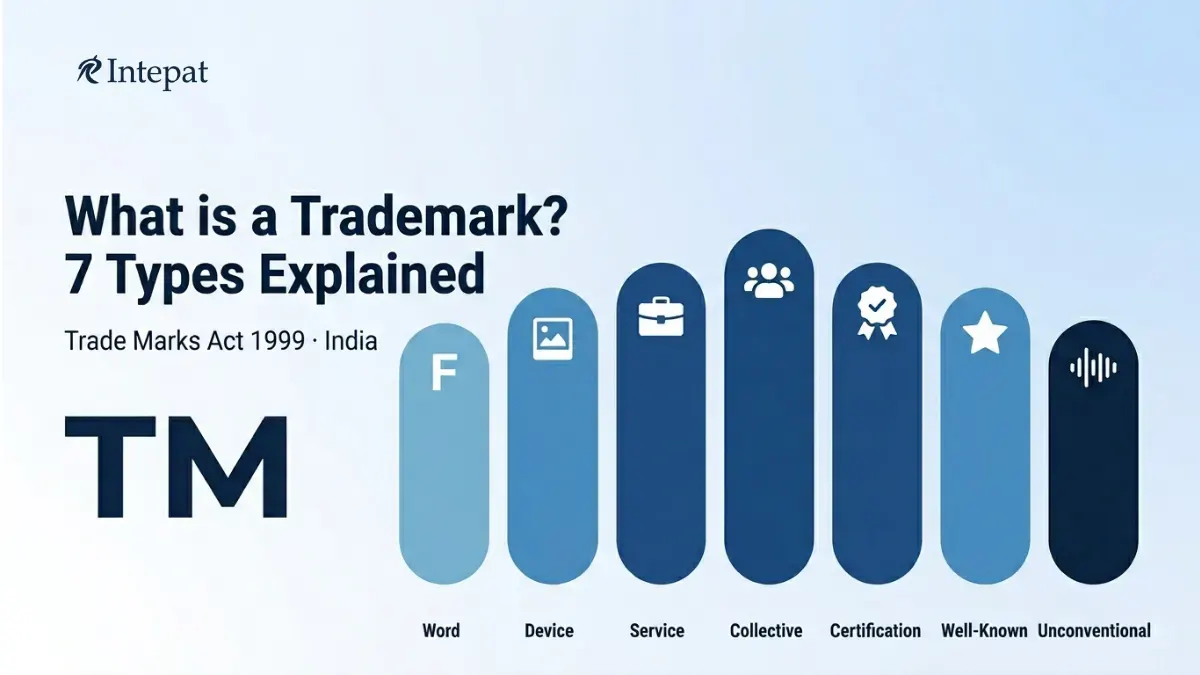
In Indian practice, trademarks are commonly grouped into seven categories: word marks, device marks, service marks, collective marks, certification marks, well-known marks, and unconventional marks such as colour, sound, shape, and smell. For how registration works, what it costs, and what it protects, see the complete guide to trademark registration in India.
Quick answer
• The type follows how the mark is used: a name is a word mark, a logo is a device mark, a service business files in the relevant service classes.
• Registration turns first on distinctiveness. Invented and arbitrary marks are inherently distinctive; descriptive marks are refused under Section 9(1) unless they have acquired a distinctive character through use before the date of filing.
• Trademark, collective, certification, and series applications are filed on Form TM-A; a request to include a mark in the Registrar’s well-known list is filed on Form TM-M under Rule 124.
• The e-filing application fee is Rs 4,500 for an individual, startup, or small enterprise and Rs 9,000 in all other cases, charged per class and per mark (verified as of June 2026).
What Is a Trademark Under Indian Law
A trademark is a sign that tells customers who is behind a product or service. Section 2(zb) of the Trade Marks Act 1999 defines a trade mark as a mark capable of being represented graphically and capable of distinguishing the goods or services of one person from those of others, and one that may include the shape of goods, their packaging, and a combination of colours.
Section 2(m) defines “mark” as a device, brand, heading, label, ticket, name, signature, word, letter, numeral, shape of goods, packaging, or combination of colours, or any combination of these. Both definitions share a single operative test: the capacity to distinguish one trader’s goods or services from another’s.
A trademark is not the same thing as a trade name, which is the name a business trades under; that distinction is covered in trade name versus trademark.
The Seven Types of Trademarks in India
The categories below describe what a mark protects, not how it is filed. A single brand often spans more than one: a startup may hold a word mark for its name and a device mark for its logo, and a services business will file the same mark as a service mark.
Word marks
A word mark protects a word, a set of letters, or a numeral on its own, independent of any styling, font, or colour. Because the right attaches to the text, not its visual presentation, a word mark gives the broadest cover for a name: it is infringed by the word however it is written. A coined brand word like a hypothetical “ZENTORA” for clothing is a typical word mark, and numerals can qualify where they distinguish, as we discuss in numerical trademarks.
Device marks
A device mark protects a logo, label, or design as an image, and may include words as part of the artwork. The right attaches to the visual whole, so a stylised bird drawn for a hypothetical café brand is protected as that artwork. A device mark suits a distinctive logo, but it protects the logo as represented, so a business that relies on its name alone is usually better served by a separate word mark.
Service marks
A service mark distinguishes the services of one provider from another, rather than physical goods. The Act protects “goods or services” throughout, so services such as banking, hospitality, transport, advertising, education, and software maintenance, which fall in Nice classes 35 to 45, are registrable on the same tests as goods. The Act defines “service” in Section 2(z) but does not define a separate “service mark”; the term is a practical label for a trade mark used for services. A consultancy name used in Nice class 36 is an everyday example.
Collective marks
A collective mark distinguishes the goods or services of members of an association from those of non-members. Section 2(g) defines it, and Chapter VIII of the Act governs it. The proprietor is the association, not the individual member, and only members may use the mark. A mark used by members of a hypothetical craft weavers’ association on their products is a typical collective mark. An application must be accompanied by regulations governing use, which set out the members, the membership conditions, and the controls the association applies. We explain the mechanics in collective trademarks in India.
Certification marks
A certification mark signals that goods or services meet a defined standard, such as composition, origin, quality, or mode of manufacture. Section 2(e) defines it and Chapter IX governs it. Unlike a collective mark, which only members of the proprietor’s association may use, a certification mark may be used by anyone whose goods or services meet the published standard. The proprietor certifies but cannot trade in the goods of the kind certified (Section 70). ISI and Woolmark are familiar certification marks in India.
Well-known marks
Well-known status is a recognition conferred on a mark, not a separate visual form like a word or device mark; a well-known mark is usually a word or logo that has earned the status through public recognition. Section 2(zg) defines it as a mark that a substantial segment of the relevant public associates with its owner, to the point that another trader’s use on unrelated goods would suggest a connection. Under Section 11(2) a later mark can be refused even for dissimilar goods if it would take unfair advantage of, or damage, the well-known mark. We set out how recognition is established in well-known trademark recognition in India.
Unconventional marks
Unconventional marks protect features beyond words and logos, provided the feature is distinctive and can be represented as the Rules require. They cover colour combinations, sounds, shapes, and smells.
- Colour: a combination of colours that has come to identify one trader’s goods, for example a specific two-colour pattern used consistently on a brand’s packaging. Section 10 allows a mark to be limited to a colour combination, and a mark registered without colour limitation is treated as registered for all colours.
- Sound: a sound that the public recognises as a badge of origin, for example a short audio jingle used consistently in advertising. Rule 26(5) requires the sound to be filed as an MP3 of not more than thirty seconds, with a graphical representation of its notation. The practical steps are in registering sound marks in India.
- Shape: the shape of goods or packaging, where it is distinctive, for example a recognisable bottle silhouette. Section 9(3) bars shapes that result from the nature of the goods, are necessary to achieve a technical result, or give substantial value to the goods. Three-dimensional trademarks are the recognised subset here.
- Smell: a scent that is distinctive and not a natural feature of the product. Smell marks are difficult in India because the graphical-representation requirement in Section 2(zb) is hard to meet for a scent, and Rule 26 sets out procedures for colour, three-dimensional, and sound marks but not for smell.
Which Type Should You File First?
The decision turns on three factors: which brand element carries the commercial weight, who controls use of the mark, and how distinctive the feature is.
| Brand situation | First filing to consider |
| The brand name is the main commercial asset | Word mark |
| The logo carries strong recognition and unique artwork | Device mark |
| Both name and logo matter independently | A word mark and a device mark, filed separately |
| The business provides services | Word or device mark in the relevant service classes (35 to 45) |
| An association controls use of a mark across members | Collective mark with regulations |
| A standards or certification body controls quality | Certification mark with regulations |
| A colour, sound, or shape itself is distinctive | An unconventional mark, with the expectation of closer examination |
| Not Sure Which Type? |
| We help match the right trademark type to your brand and file it correctly. |
| Speak to Expert |
Which Marks Register and Which Get Refused
Practitioners rank marks on a spectrum of inherent strength, from fanciful to generic. Where a mark sits on the spectrum largely determines how it fares on examination.
| Strength | What it is | Example | Registrability |
| Invented / fanciful | A coined word with no meaning | A made-up brand name | Strongest |
| Arbitrary | A real word unrelated to the goods | A common noun on unrelated products | Strong |
| Suggestive | Hints at a quality without describing | A name needing some imagination | Often registrable |
| Descriptive | Describes the goods or a quality | A flavour claim for food | Refused unless distinctiveness is acquired |
| Generic | The common name of the product | The product category itself | Not registrable |
Investing in an invented or arbitrary mark costs the same to file as a descriptive name but is harder to challenge and easier to enforce.
The Act divides the grounds for refusal into two kinds. Section 9 tests the mark in isolation: a mark is refused if it is devoid of distinctive character, if it consists exclusively of indications that describe the kind, quality, quantity, intended purpose, value, geographical origin, or time of production of the goods, or if it has become customary in the trade. A proviso saves a mark that has acquired distinctive character through use before the application date, or that is already a well-known mark. Section 9 also refuses marks that deceive, hurt religious sentiments, or are scandalous or obscene.
Section 11 tests the mark against earlier rights: a mark is refused where its identity or similarity to an earlier mark, on identical or similar goods, creates a likelihood of confusion, including a likelihood of association. Section 11 also extends the cross-class protection that well-known marks enjoy. Under Section 17(1) registration of a composite mark protects the whole mark, and Section 17(2) withholds exclusive rights in parts that are common to the trade or otherwise non-distinctive. The overall impression governs, but dominant and distinctive elements carry more weight than descriptive or common parts. We unpack both heads in Sections 9 and 11: grounds for trademark refusal and the distinctiveness question in distinctiveness versus descriptiveness.
Practitioner note: the well-known route is now a filing, not only a court finding. A mark can be recognised as well-known by a court or the Registrar in a dispute, but it can also be added to the Registrar’s published list on a direct request. Under Rule 124, any person may apply on Form TM-M, with a statement of case and supporting evidence, for a fee of Rs 1,00,000 (e-filing only, verified as of June 2026). The Registrar weighs the factors in Section 11(6) to (9) and may invite public objections within thirty days before deciding.
Filing Routes and Fees at a Glance
Every route uses Form TM-A; what changes is the number of classes, the supporting documents, and any priority claim.
| Route | What it does | Filed on | Notes |
| Single-class | One mark in one class | TM-A | Simplest filing |
| Multiclass | One mark across several classes | TM-A | Fee is charged per class (Section 18(2)) |
| Series | Several closely resembling marks in one application | TM-A | Permitted under Section 15(3); marks must match in material particulars |
| Convention | Claims priority from an earlier foreign filing | TM-A | Six-month window under Section 154; priority certificate required (Rule 24) |
| Collective | Mark for members of an association | TM-A | Filed with draft regulations governing use (Rule 131) |
| Certification | Mark certifying a standard | TM-A | Filed with draft regulations (Rule 137) |
The application fee under the First Schedule depends on who the applicant is, not which route is used.
| Applicant | E-filing (per class, per mark) | Physical filing (per class, per mark) |
| Individual / startup / small enterprise | Rs 4,500 | Rs 5,000 |
| All other applicants | Rs 9,000 | Rs 10,000 |
Each mark and each class attracts a separate fee. A startup filing a word mark and a device mark in two classes pays four application fees; settle the combination before filing.
A multiclass application is one filing but the fee is charged for each class, so an individual filing in three classes pays three times Rs 4,500 by e-filing; the saving is in paperwork, not fees, and an objection or opposition to any one class can hold up the whole application. The trade-offs are covered in multiclass applications. A series application lets a proprietor register marks that resemble each other in their material particulars but differ in non-distinctive details, as explained in series trademarks; it is not a way to bundle unrelated marks.
Frequently Asked Questions
Indian law recognises word marks, device marks, service marks, collective marks, certification marks, well-known marks, and unconventional marks including colour, sound, shape, and smell. All are tested against the same fundamental requirement under Section 2(zb) of the Trade Marks Act 1999: the capacity to distinguish one trader’s goods or services from those of others.
A collective mark is used by members of one association and identifies membership, governed by Chapter VIII. A certification mark signals that goods meet a defined standard and may be used by anyone who meets it, governed by Chapter IX. The certifier cannot trade in the goods it certifies, under Section 70 of the Act.
Applications to register a word, device, service, collective, certification, or series mark are filed on Form TM-A under the Trade Marks Rules 2017, in single-class, multiclass, or convention form. Collective and certification applications include draft regulations. A request for well-known mark inclusion is filed separately on Form TM-M under Rule 124.
A purely descriptive word is refused under Section 9(1)(b) of the Trade Marks Act 1999, because it describes the goods rather than distinguishing them. It can be registered only where it has acquired a distinctive character through use before the application date, which must be proved, or where it already qualifies as a well-known mark.
A trademark becomes well-known when a substantial segment of the relevant public associates it with its owner. Recognition can come from a court or Registrar in a dispute, or from a direct application under Rule 124 on Form TM-M with supporting evidence, for which the Registrar weighs the factors in Section 11(6) to (9).
If the brand name is distinctive on its own, file the word mark first because it protects the name in any styling, font, or colour. Add a device mark where the logo carries independent commercial value or is used prominently in marketing. Each is a separate mark and attracts a separate fee per class.
The e-filing application fee under the First Schedule to the Trade Marks Rules 2017 is Rs 4,500 for an individual, startup, or small enterprise, and Rs 9,000 for all other applicants, charged per class and per mark. Physical filing costs Rs 5,000 and Rs 10,000 respectively.
Disclaimer: This article explains the types of trademarks under the Trade Marks Act 1999 and the Trade Marks Rules 2017 for general information only and is not legal advice. Fees and procedures are Registry-dependent and change over time; the figures here are stated as verified in June 2026. Whether a particular mark is registrable, and which type and route suit it, depends on the specific facts. Seek professional advice before filing or relying on any position stated here.